Exploring the Role of Quantum Dot–Based Nanotechnologies for Nematode Detection and Management: A Review
Aditya Pratap Singh
Department of Plant Pathology & Nematology, Post Graduate College of Agriculture, Dr. Rajendra Prasad Central Agricultural University, Samastipur (848125), Bihar, India.
Shashi Kant Thakur *
Banana Research Center, Goraul, Vaishali, Dr. Rajendra Prasad Central Agricultural University, Samastipur (848125), Bihar, India.
Nishi Keshari
Department of Plant Pathology & Nematology, Dr. Rajendra Prasad Central Agricultural University, Samastipur (848125), Bihar, India.
Sunil Sharma
Department of Plant Pathology & Nematology, Post Graduate College of Agriculture, Dr. Rajendra Prasad Central Agricultural University, Samastipur (848125), Bihar, India.
Ankit Kumar
Department of Soil Science and Agricultural Chemistry, Bihar Agricultural University, Sabour, Bhagalpur (813210), Bihar, India.
Aditya Kumar Prajapati
Department of Vegetable Science, College of Horticulture and Forestry, Agriculture University, Kota, Jhalawar, Rajasthan, India.
Suman Meena
Department of Plant Pathology and Nematology, PGCA, RPCAU, Pusa, India.
Ankush Kumar Dey
Department of Plant Pathology and Nematology, PGCA, RPCAU, Pusa, India.
*Author to whom correspondence should be addressed.
Abstract
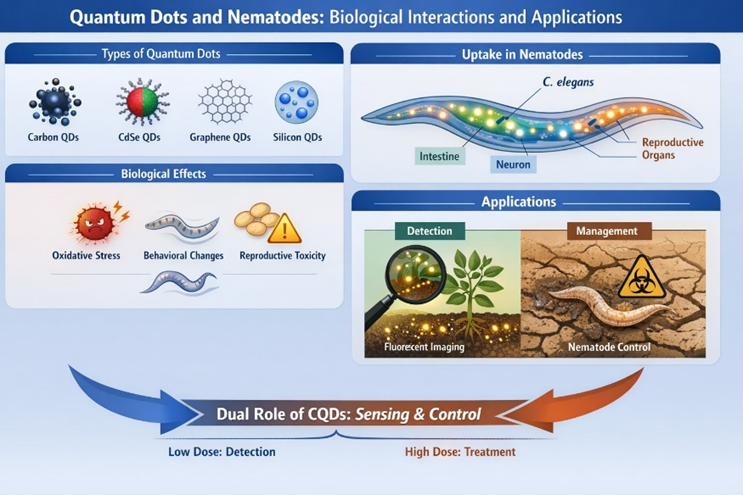
Nematodes constitute a highly diverse and widely distributed group of metazoans, inhabiting a variety of environments such as soil, freshwater and marine ecosystems. Despite their ecological importance, their study is often constrained by their microscopic size and the limited availability of tools for observing their behavior under real-time conditions. In agricultural systems, the management of plant-parasitic nematodes continues to depend largely on chemical nematicides, which raise concerns due to their adverse effects on the environment and human health. In recent years, carbon quantum dots (CQDs) have emerged as a promising nanomaterial with potential applications in nematology. This review synthesizes current research on the use of CQDs in nematode detection, visualization and management. Evidence from studies on plant-parasitic nematodes (Bursaphelenchus xylophilus), entomopathogenic nematodes (Steinernema spp.) and the model organism (Caenorhabditis elegans) suggests that CQDs exhibit concentration-dependent behavior. At lower concentrations, they act as effective and biocompatible fluorescent probes, facilitating in vivo tracking without causing significant adverse effects. However, at higher concentrations, CQDs may induce physiological stress, likely associated with prolonged exposure and accumulation within the organism. Taken together, CQDs present a useful platform for integrating detection and management approaches in nematology. Nevertheless, further investigation is needed to better understand their long-term effects, optimize their application and ensure their safe use in agricultural systems.
Graphical Abstract
Keywords: Quantum dots, nematode detection, nanotoxicology, xenobiotic metabolism sustainable nematode management